

Reliable data pipeline and warehouse.
Prefetched data for faster loads.
Supports Looker Studio, BigQuery and more.
Legacy Reportdash Platform.
Data fetched on demand.
Export to Google Sheets or Looker Studio.

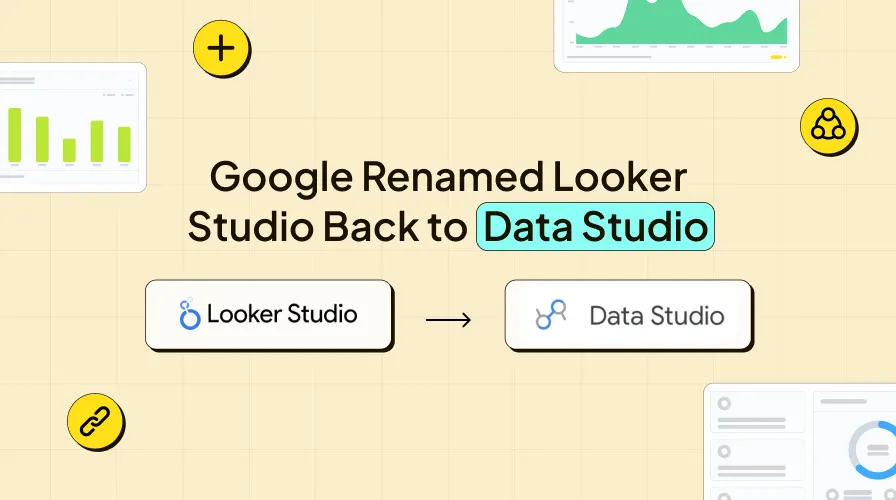
On April 11, 2026, Google renamed Looker Studio back to Google Data Studio. If you're pulling cross-channel data into dashboards, here's what matters and what you can ignore.
Why Google Brought Back the Data Studio Name
When Google renamed Data Studio to Looker Studio in October 2022, the logic was sound. Google had acquired Looker for $2.6 billion. Looker was the enterprise BI platform. Data Studio was the lightweight, free reporting tool. A shared name was meant to signal a unified portfolio.
What Google heard from customers was different. The shared naming made it harder to choose the right tool. Enterprise teams couldn't distinguish which "Looker" product fit their use case. Two strong products were working against each other simply because they shared a name.
Google listened. The rename reflects that feedback.
Data Studio vs Looker: Two Products, Two Names
Data Studio is for personal data exploration, ad-hoc reporting, and quick visualizations. It's free, self-service, and built for individual analysts and agency teams. It connects to BigQuery, Google Sheets, Google Ads, and more.
Looker is the enterprise BI platform. It's built around governed data, LookML semantic modeling, and agentic AI capabilities. It's designed for organizations where consistent, trusted metrics across teams matter more than speed.
Before this rebrand, that distinction existed but the naming obscured it. Now the product names do the explaining.
What's New: Data Studio Pro
Google introduced Data Studio Pro for scaling teams that need more control. Enterprise-grade security. AI features. Compliance capabilities. Deeper Google Cloud integration.
Pro licenses are available through the Google Cloud console or Google Workspace Admin Console. It sits between the free Data Studio experience and the full Looker platform.
If You're Using Reportdash
If you're using Reportdash to pull cross-channel data from Google Ads, Meta, LinkedIn, or GA4 and push it into Data Studio, your workflow stays the same. Reports, data sources, and connectors migrate automatically. No action needed.
The practical work: audit your templates and onboarding decks. Agencies running reports labeled "Looker Studio" should update documentation before clients notice the name change themselves.
Should You Update Your Reporting Stack
Not immediately. The underlying product is the same. What changes is strategic clarity.
For teams deciding between self-service reporting and fully governed BI, the choice is now cleaner. Data Studio handles fast, Google-native dashboards for marketing and analytics teams. Looker handles the semantic layer work where every metric needs to be defined once and trusted everywhere.
If you've been sitting on that decision, the naming shift gives you a clearer framework to make it.
The Bottom Line
Google Data Studio returning is less about a name change and more about Google clarifying what each product is actually for. Marketers get back a familiar brand with an expanded role. Enterprise BI teams get a Looker platform that no longer shares its identity.
For most marketing teams, day-to-day reporting carries on unchanged. The bigger win is clarity: two products, two audiences, two names that reflect that distinction.
One pipeline. One destination. One set of unified, trustworthy metrics.

Clean, unified marketing data in a few clicks.

Unify cross-channel marketing data, preserve historical records, and generate reports faster. Your data, your way.