What is data activation and why it matters for businesses in 2026

It's a regular workday.
You open your dashboard. Numbers look fine. Marketing asks for a customer list. Sales wants intent data. Ops needs a report for leadership. Someone exports a CSV. Someone else pastes it into another tool. By the time anything actually happens, the moment has already passed.
If you're running a modern business, you'll know this feeling. Your data stack is full, demand for insights never stops, and teams are still waiting days for answers that should take minutes.
Data activation is the practice of turning your existing data into actions inside the tools your teams already use.Instead of raw data living in reports and dashboards, it flows directly into operational tools like marketing platforms, CRM systems, customer support software, and internal workflows where it can trigger decisions in real time.
Most businesses don't struggle with data because they lack it. They struggle because it's stuck. It's spread across data warehouses, owned by different teams, and accessed only when someone asks for it. Decisions slow down. Manual work piles up. And over time, teams stop trusting the data altogether.
As companies head into 2026, this friction becomes harder to ignore. Businesses use more software than ever. Customers expect faster, more personalized customer experiences. And teams don't have the patience to wait for weekly reports to tell them what they should have done yesterday.
This is where data activation starts to matter. Not as a technical upgrade, but as a shift in how businesses actually use customer data they already have.
Why is data activation important for businesses today?
Here's what most businesses don't realize: 68% of enterprise data remains unleveraged. That's not a small gap. That's the majority of your data sitting unused while teams scramble for insights.
When customer data lives in separate tools, teams end up working with partial context. Marketing sees one version of the customer. Sales teams see another. Support sees something else entirely. Decisions are made, but they're made in isolation. Over time, this creates misalignment, duplicated work, and missed opportunities that never show up clearly on a balance sheet.
The cost isn't just inefficiency. It's timing:
A lead is most valuable at the moment of intent
A customer issue is easiest to fix before it becomes a complaint
An operational signal matters most before it turns into a problem
When data arrives late or in the wrong place, businesses don't just lose insight. They lose momentum.
This is also why traditional reporting is no longer enough.
Dashboards are useful for understanding what already happened. But they don't help teams act while something is happening. By the time a report is reviewed, the window to respond has often closed. Teams are left explaining outcomes instead of influencing them.
As businesses scale and systems multiply, this gap only widens. More tools mean more data. More data means more reports. And without activation, more reports simply mean more waiting.
Data activation closes this gap. It moves data out of passive dashboards and into active workflows, where decisions are made in real time.
What changes when data becomes activated?
The biggest change isn't better dashboards. It's what teams can do without waiting.
When data is activated, it shows up inside operational tools people already use to get work done. Marketing teams don't ask for lists. Sales teams don't wait for signals. Support doesn't dig through history. The right data is already there, at the moment it's needed.
Here's what that looks like in practice:
Decisions happen in real time, not in weekly reviews
Teams act on live signals instead of static reports
Data moves to people and tools, instead of people chasing data
This shift changes how work actually gets done.
Instead of reacting to what happened last week, teams respond to what's happening now. A customer action triggers a follow-up. A usage pattern flags a risk. A business signal leads to an immediate adjustment, not a post-mortem.
As activated data becomes part of everyday workflows, businesses start to see:
Fewer manual exports and ad-hoc reports
Faster response times across teams
More consistent and personalized customer experiences
Less debate about which numbers are "correct"
Over time, these changes compound. Manual work disappears. Bottlenecks shrink. And leadership gains confidence that business outcomes are based on what's actually happening across the business.
How does data activation work?
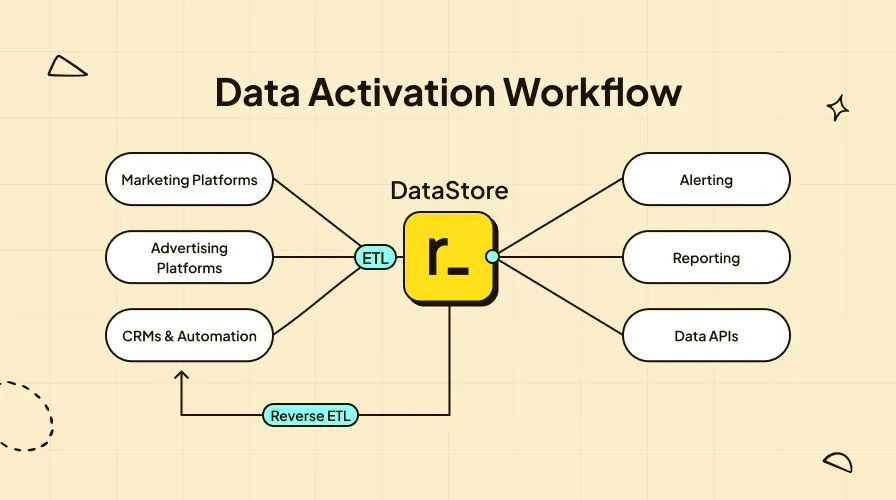
At a high level, the data activation process isn't complicated. It's about making sure the right data reaches the right place at the right time.
Most businesses already have the pieces. Data is being collected across business tools. Reports are being generated. The missing step is turning that raw data into something teams can act on without friction.
The 3 stages of data activation:
1. Data collection from everyday business systems
This includes tools like your CRM, marketing platforms, product analytics, billing systems, and support software. Nothing new here—this data already exists.
2. Data unification and preparation
Instead of living in data silos, data is cleaned, standardized, and connected so it reflects a single, consistent view of customers, accounts, and activities. This is where data warehouses and data integration come in, transforming raw data into actionable insights.
3. Data delivery to operational tools
This is the key shift. Data flows into marketing tools, CRM systems, customer support platforms, and internal workflows where it can trigger actions automatically or guide decisions in real time.
Data activation vs. traditional reporting:
Traditional Reporting | Data Activation |
|---|---|
Explains what already happened | Influences what happens next |
Creates static dashboards | Enables real-time action |
Requires manual exports | Flows automatically to tools |
Teams wait for insights | Teams work with live data |
For business teams, this means fewer requests, fewer delays, and fewer manual processes. Teams don't wait for valuable insights. They work with them as part of their daily tools.
How do different teams use data activation?
Data activation matters because it fits into how teams already work. No new habits to learn. No extra steps to follow. Just better information showing up at the right time.
Here's how that plays out across teams.
Marketing and growth teams
Marketing teams use activated data to respond to real customer behavior instead of assumptions. Marketing campaigns adjust based on what customers are actually doing, not what a report says they did last week.
Key benefits:
Build sophisticated audiences using behavioral data and customer attributes
Launch data driven marketing strategies without data engineers
Deliver better timing and more relevant messaging
Reduce wasted spend across marketing channels
By syncing customer data directly into marketing automation platforms, teams can act on signals in real time.
Sales and revenue teams
Sales teams benefit when signals are immediate. When interest, intent, or product usage changes, that information is already visible in their business tools.
Key benefits:
Access detailed insights into leads automatically
See behavioral patterns and customer behavior in context
Have more informed, better-timed conversations
Stop relying on outdated notes or chasing updates
Data activation equips sales teams with the context they need at exactly the right moment.
Customer support and success teams
Customer success teams use activated data to understand context before problems escalate. They can see usage patterns, recent customer interactions, and account health in one place.
Key benefits:
Create automated alerts for at-risk customers
Respond faster with complete context
Turn data points into action before churn happens
Shift from reactive to proactive support
This makes responses faster and more proactive, not reactive.
Leadership and operations
For leadership, data activation creates consistency. Teams operate from the same underlying data instead of conflicting reports.
Key benefits:
Clearer planning and more reliable forecasts
Easier to defend decisions with real-time data
Better visibility into business outcomes
Confidence that teams are aligned
Across all teams, the pattern is the same. Less waiting. Fewer handoffs. More confidence in day-to-day decisions.
What challenges do businesses face with data activation?
Most data activation efforts don't struggle because the idea is flawed. They struggle because the reality of day-to-day operations gets in the way.
Challenge 1: Data fragmentation
Customer data is spread across multiple tools, teams, and systems, each with its own owner and definition. When no one owns the full data flow, implementing data activation becomes inconsistent.
This usually shows up as:
Different teams working with different versions of the same data
Conflicting reports across tools
Delays caused by manual reconciliation
Challenge 2: Over-reliance on data teams
When business teams can't act without engineering support, even small changes take time.
The result is often:
Long wait times for simple data updates
Backlogs that slow down execution
Business teams reverting to spreadsheets
Challenge 3: Data quality issues
If teams don't trust the data, they stop using it—no matter how well it's activated.
Common signs include:
Outdated or incomplete records
Inconsistent naming and definitions
Decisions being second-guessed or ignored
Challenge 4: Complexity overload
Data activation efforts can quickly turn into a large project when too many tools or processes are introduced at once.
This leads to:
Higher operational overhead
Slower time to value
Teams disengaging from the process
These challenges are normal, not exceptional. The businesses that enable data activation successfully are the ones that address these issues head-on.
How can businesses overcome data activation challenges?
Overcoming data activation challenges doesn't require rebuilding everything. It requires a few deliberate choices that align data with how teams actually work.
1. Establish clear data ownership
Data activation works best when responsibility is clear, not spread thin across teams.
Strong data ownership means:
Clear accountability for key data sets
Shared definitions across teams
Fewer handoffs and approvals
2. Reduce dependency on engineering
The data activation benefit is greatest when it empowers business teams, not bottlenecks them.
This usually involves:
Tools that allow non technical users to work with data
Predefined workflows instead of custom data pipelines
Changes that don't require code for every update
3. Build data trust
Teams need confidence before they act.
Building trust comes from:
Consistent definitions and logic
Visibility into where data comes from
Regular validation instead of ad-hoc fixes
4. Start simple and scale gradually
Businesses see faster results when they start small and expand gradually.
A practical approach looks like:
Activating a few high-impact signals first
Avoiding unnecessary tooling early on
Expanding only after business value is clear
When these foundations are in place, data activation stops feeling like a project and starts feeling like part of normal operations.
How can businesses get started with data activation?
Getting started with data activation doesn't require a big transformation or a long-term commitment. In fact, the most successful teams start small on purpose.
The simplest approach is to begin with one problem that keeps coming up. Maybe it's slow follow-ups, inconsistent customer data, or too much manual reporting. Data activation works best when it's tied to a real business bottleneck, not a broad initiative.
A practical 3-step approach:
Step 1: Identify one high-impact use case
Look for a specific problem that's slowing your team down. This could be lead scoring delays, customer churn signals being missed, or marketing segments taking days to update.
Step 2: Activate a small set of reliable data signals
Don't try to activate everything at once. Choose 3-5 key data points that matter most for your chosen use case.
Step 3: Apply them inside tools teams already use
Push these signals directly into your CRM systems, marketing automation platforms, or customer success tools where teams already work.
This approach limits risk while creating visible wins early. Teams see value quickly, confidence builds, and adoption grows naturally.
Importantly, getting started doesn't mean locking yourself into a rigid setup. Data activation should evolve as the business grows. Starting small keeps things flexible and avoids unnecessary complexity.
How should business leaders measure the success of data activation?
The success of data activation isn't measured by how much data you move. It's measured by what changes in the business.
Early operational indicators:
Faster response times across teams
Reduced reliance on spreadsheets and exports
Fewer data-related blockers in daily work
Decreased time from insight to action
Early signs often show up in operations before they show up in revenue. Decisions happen faster. Fewer requests bounce between teams. Manual work decreases.
Long-term business outcomes:
Improved conversion or retention rates
Better forecast accuracy
Higher customer satisfaction scores
Lower customer acquisition cost through better targeting
More confident decision-making at leadership level
Over time, business-level outcomes become clearer. The key is to measure what matters to your business, not what's easiest to track. If data activation helps teams act with less friction, it's doing its job.
What are the most common questions business owners ask about data activation?
Is data activation only for large or technical teams?
No. Many businesses adopt data activation specifically to reduce dependency on technical teams and simplify everyday decision-making. The right data activation platform makes data accessible to non technical users through self-service tools and workflows that don't require data engineers.
Does this replace our existing tools or dashboards?
No. Data activation works alongside your existing data infrastructure. It improves how data is used, not where it lives. Think of it as a layer that connects your data warehouse to your operational tools, making your entire data stack more useful.
How long does it take to see value?
Small, focused use cases often deliver results in weeks, not months. Just a few examples:
Automated customer segments in your marketing automation platform
Real-time alerts in your CRM systems
Behavioral triggers for customer success
Is this risky to implement?
It doesn't have to be. Starting small and expanding gradually keeps risk low and learning high. The data activation lifecycle should be iterative, not a massive overhaul.
What's the difference between data activation and traditional BI?
Traditional business intelligence focuses on reporting what happened. Data activation focuses on enabling action on what's happening now. BI explains; activation enables.
Where ReportDash fits in
Many businesses reach a point where they want to activate their data, but don't want to rebuild their entire modern data stack or risk losing historical context along the way.
This is the gap ReportDash DataStore is designed to solve. Instead of treating data as something that's pulled and discarded, DataStore acts as a long-term, unified layer where your marketing data, sales data, and operational data is stored and made usable over time.
Key advantages of ReportDash DataStore:
Historical data retention: Data is retained from the moment you connect your tools
Unified data layer: All your business data in one reliable place
Activate current and historical data: No rework needed to access past performance
Consistent comparisons: Comparisons remain accurate even as tools change
No data loss: Business data doesn't disappear when dashboards or tools change
For businesses thinking about data activation, this kind of foundation matters. When data is reliable, unified, and preserved over time, activating it becomes simpler and far less risky.
Closing thoughts
Most businesses don't need more data. They need their data to work harder.
Data activation isn't about adding another system or chasing trends. It's about closing the gap between insight and action. When data shows up where work happens, teams move faster, decisions improve, and businesses operate with more confidence.
As we move into 2026, this shift becomes less optional and more foundational. The data pipeline tools market is experiencing 26% compound annual growth, and companies prioritizing data activation initiatives are finding measurable improvements in operational efficiency and customer loyalty.
Businesses that activate their data don't just understand what's happening. They're able to respond while it still matters.
If your data feels underused today, the opportunity isn't to collect more of it. It's to activate what you already have, on top of a foundation that's built to last.