What is a marketing data warehouse and why should you care about it?
A marketing data warehouse is a centralized repository that stores, organizes, and analyzes marketing data from multiple sources in one place. It acts as a long-term, structured data storage system where marketing teams can access clean, consistent, and historical data for analysis.
Unlike dashboards or spreadsheets, a data warehouse is built to handle large data volumes without losing accuracy over time. Think of it as your marketing data's permanent home, one that doesn't forget, doesn't break when you switch tools, and doesn't vanish when platforms update their APIs.
In simple terms, what does it do?
Collects data from multiple marketing platforms
Stores structured data and historical marketing data
Makes data ready for analysis and reporting
Acts as a single source of truth for marketing teams
A marketing data warehouse typically stores data from ad platforms, analytics tools, CRM systems, and marketing automation tools. This gives marketers the freedom to analyze performance across marketing channels without manually exporting or reconciling data.
Why do you actually need a data warehouse?
Marketing teams use data warehousing solutions to answer questions that dashboards alone cannot support. These include long-term performance trends, cross-channel attribution, and customer behavior analysis.
Here's the thing: your Google Analytics dashboard is great for checking yesterday's traffic. Your Google Ads interface shows you today's campaign performance. But when you need to understand how your marketing strategies have evolved over two years, or which customer touchpoints actually drive conversions across social media platforms, email, and paid ads? That's where a marketing data warehouse comes in.
According to Bain & Company, companies using advanced analytics are 5× more likely to make faster decisions than competitors.
How does a marketing data warehouse compare to databases, Data lakes, and data marts?
A marketing data warehouse is designed for analytics and long-term insights, while other data storage systems serve very different purposes.
Understanding these differences helps marketers choose the right foundation for reporting, analysis, and business growth.
Data storage type | Primary purpose | Data format | No. of data sources | Storage capacity |
|---|---|---|---|---|
Data warehouse | Analytics & reporting | Structured data | Many | Very high |
Database | Operational usage | Structured data | Few | Limited |
Data lake | Raw data storage | Structured & unstructured data | Many | Extremely high (petabyte scale) |
Data mart | Team-level analysis | Structured data | Few to moderate | Moderate |
What is a data warehouse?
A data warehouse is built to store structured data optimized for analysis and reporting at scale. It acts as a centralized repository where historical data remains accessible even as tools and dashboards change.
Stores clean, structured data, and historical marketing data
Supports fast querying for analytics and BI tools
Scales across channels and large data volumes
Creates a single source of truth for teams
What is a database?
A database is designed to manage live, transactional data used by applications and operational systems. It prioritizes speed for updates and reads, not complex analytical queries.
Not optimized for large historical datasets
Slows down when running complex queries
Better suited for operations than reporting
What is a data lake?
A data lake stores raw data in its original format, including unstructured data and semi-structured data. It offers flexibility but requires additional processing before meaningful analysis.
Stores raw data with minimal structure
Requires technical effort to clean and model data
Better for data science than day-to-day reporting
What is a data mart?
A data mart is a smaller, focused subset of a data warehouse designed for a specific team or function. Marketing data marts pull relevant data from the main warehouse for faster, targeted analysis.
Provides focused access to relevant marketing metrics
Improves reporting speed for specific use cases
Depends on the warehouse for data accuracy and consistency
Why do marketing teams struggle with scattered data across multiple platforms?
Marketing and analytics teams struggle with scattered data because each platform stores data in isolation and follows its own structure. Ad platforms, analytics tools, CRM systems, and marketing automation tools rarely speak the same data language.
This forces marketers to manually export data, reconcile it, and validate it before any real analysis begins. You know the drill: download a CSV from Google Ads, another from Facebook, pull a report from your email platform, then spend an hour trying to figure out why the conversion numbers don't match.
What actually causes data fragmentation?
Each marketing platform acts as its own data silo
Marketing metrics definitions vary across tools
Data lives in multiple dashboards instead of one centralized system
Manual export data processes increase errors and delays
According to Salesforce, 73% of marketers say data silos limit their ability to deliver relevant experiences.
What happens to marketing data when tools or dashboards change?
When tools or dashboards change, historical marketing data often becomes inaccessible or incomplete. Dashboards usually show only current configurations, not past logic or transformations.
As a result, previous reports break and year-over-year comparisons become unreliable. This means marketing teams lose context, not just data. You're not just missing numbers—you're missing the story of what worked, what didn't, and why.
Why is historical marketing data so difficult to preserve over time?
Historical data is hard to preserve because most marketing platforms prioritize recent performance over long-term data storage.
APIs change, marketing metrics are deprecated, and platforms limit how far back data can be queried. Without a centralized repository, older data slowly disappears or becomes unusable. Google Analytics sunsets a property? Your data from multiple sources vanishes. Switch from one marketing automation tool to another? Kiss your campaign history goodbye.
Gartner reports that poor data quality costs organizations an average of $12.9 million annually.
How does this impact marketing decisions?
When historical data is missing, teams rely on short-term trends instead of long-term insights. This leads to reactive decisions, inconsistent reporting, and misaligned marketing strategies.
Over time, confidence in marketing data starts to erode across teams. Finance questions your ROI calculations. Leadership doubts your attribution model. And you're stuck explaining why Q4 2023's numbers can't be compared to Q4 2024.
How does a marketing data warehouse solve this problem?
A marketing data warehouse stores data independently from dashboards and reporting tools. It continuously collects data from multiple marketing platforms and preserves it in structured data format.
This creates a single source of truth that remains consistent even when tools change. Instead of rebuilding reports, teams simply query the same reliable data layer. The warehouse becomes your insurance policy against platform changes, tool migrations, and dashboard updates.
ReportDash Datastore makes this process simple for marketing teams. Once you connect a data source, your data is stored safely from that day onward.
The sooner you connect your platforms, the more historical data you protect from being lost. Your data stays available even when dashboards change or tools are replaced.
How does a marketing data warehouse bring data together from multiple sources?
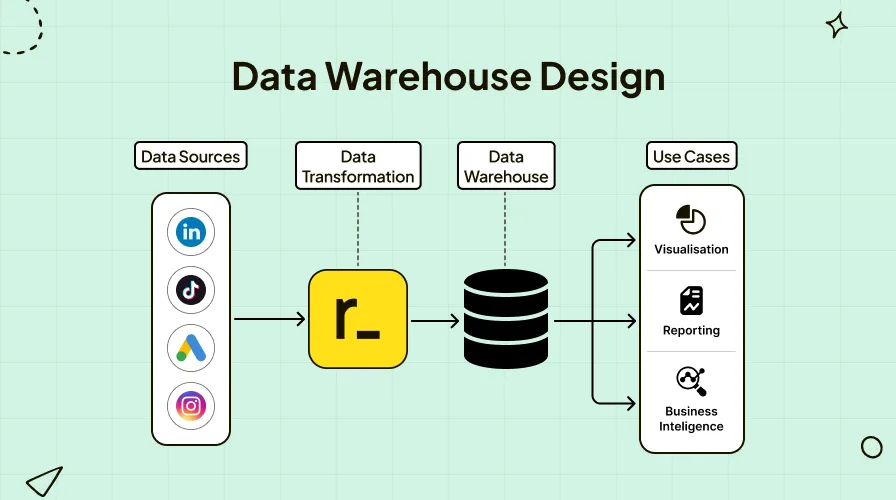
A marketing data warehouse pulls data from different platforms and stores it in one centralized repository. This happens automatically through integrations, APIs, and scheduled data pipelines, removing the need for manual export data processes.
Most data warehousing solutions connect to ad platforms like Google Ads and Bing Ads, social media platforms, CRM systems, and marketing automation tools. This ensures marketing data from every marketing channel is available in one place for data analysis.
Data collection happens using automated extraction and loading processes that run at regular intervals through a data pipeline. These processes reduce delays and prevent data gaps that commonly occur with manual reporting.
According to Fivetran, automated data integration processes can reduce data engineering effort by up to 80%. This allows marketing teams to focus more on analysis and less on data management.
Once data enters the warehouse, it's standardized into a consistent data model. Marketing metrics are aligned, duplicates are removed, and naming conventions are cleaned for data accuracy.
Centralizing data reduces manual handling, which is a major source of reporting errors. When you consolidate data from multiple sources, you eliminate the inconsistencies that come from different platforms measuring "conversions" or "sessions" differently.
McKinsey reports that data-driven organizations are 23× more likely to acquire customers than competitors.
Platforms like ReportDash Datastore simplify this entire data integration process for marketing teams. Once a data source is connected, data is stored securely from that day onward, protecting valuable historical data.
How is marketing data modeled and stored for long-term analysis?
Marketing data is modeled by organizing raw data inputs into structured data tables that are easy to query and analyze data. This structure ensures marketing metrics remain consistent across marketing campaigns, channels, and time periods.
A clear data model maps each data source to defined dimensions and metrics. This makes reporting predictable and prevents confusion when marketing teams analyze the same data differently. No more arguments about whether that spike in revenue came from paid search or organic, everyone's looking at the same numbers, defined the same way.
Once modeled, data is stored in a centralized repository built for scale and durability. This allows marketing teams to access historical marketing data without worrying about performance issues.
Structured data storage also makes it easier to run complex queries across large datasets. This is essential for trend analysis, cohort studies, and year-over-year comparisons, the kind of deeper data analysis that actually moves the needle on marketing performance.
Cloud based data warehouse solutions separate storage and compute resources. This design allows teams to scale data volume without slowing down analytics. Whether you're storing data from three marketing channels or thirty, the analytics solutions perform the same.
According to Google Cloud, modern cloud data warehouses can handle petabyte-scale data while maintaining fast query performance. This makes long-term marketing analytics both reliable and efficient.
By storing data in this way, marketing teams gain a dependable data infrastructure for analytics. Data remains accessible, accurate, and ready for future reporting needs.
When should you start storing your marketing data in a warehouse?
You should start storing your marketing data in a data warehouse when your business begins to grow in size or complexity.
As marketing channels, marketing campaigns, and tools increase, reporting becomes harder to manage with basic setups. Spreadsheets start breaking. Google Data Studio dashboards take minutes to load. Your data analysts spend more time reconciling numbers than actually analyzing them.
At this stage, data fragmentation is no longer a temporary issue. It becomes a structural problem that slows down decision-making.
When your business starts growing in size or complexity
Growth usually means more marketing platforms, more data sources, and higher data volume. Each new tool adds another layer of reporting complexity.
Spreadsheets and dashboards may work initially, but they don't scale well. Over time, they introduce errors, delays, and inconsistent marketing metrics. You're hiring more people, running more campaigns, and suddenly nobody can agree on what "conversion rate" means.
A marketing data warehouse provides a centralized repository that can handle growing data volumes. It ensures data remains accessible and reliable as your business scales.
When you need better visibility into ROI, ROAS, and attribution
Understanding marketing ROI and ROAS requires consistent and historical marketing data. Most marketing platforms only show partial performance within their own ecosystem. Google Ads tells you what happened in Google Ads. Your email platform shows email metrics. But what's the full customer journey that leads to a purchase?
Attribution becomes especially challenging when data lives across multiple sources. Without consolidation, it's difficult to understand what actually drives conversions and impacts customer behavior.
A marketing data warehouse consolidates data from all marketing channels into one place. This enables deeper data analysis of marketing performance and more confident budget decisions. Accurate attribution depends on having the right data infrastructure in place.
What's a simple rule of thumb for marketing teams?
If reporting feels harder every month, it's a signal to rethink your data storage setup. The earlier data is stored centrally, the more historical marketing insights you preserve.
Starting early prevents data loss and avoids costly rebuilds later. A marketing data warehouse implementation turns growing data into a long-term strategic asset. Think of it this way: every day you wait is another day of marketing data you'll never get back.
What are the key steps in marketing data warehouse implementation?
Marketing data warehouse implementation starts with clarity, not tools. The goal is to create a reliable data infrastructure that supports analysis today and business growth tomorrow.
How do you start by defining business goals and reporting needs?
Implementation should begin with clear marketing objectives. Marketing teams need to know which marketing metrics, marketing channels, and outcomes matter most.
This prevents collecting unnecessary data and keeps the warehouse focused on relevant data. Clear goals also make reporting more consistent across marketing and analytics teams.
Don't just connect every possible data source because you can. Figure out what questions you actually need to answer, then build toward that.
How do you identify and prioritize your key marketing data sources?
Not all data sources need to be connected at once. Most marketing teams start with ad platforms, web analytics, and CRM systems, your key marketing data sources.
Prioritizing high-impact sources reduces complexity early on in the data integration process. Additional platforms can be added as reporting needs evolve. Start with the 20% of data sources that give you 80% of the insights.
How do you set up data integration and pipelines?
Data integration connects your marketing platforms to the warehouse automatically through a marketing data pipeline. Pipelines control how often data is collected and updated through data collection processes.
Automated pipelines reduce manual effort and minimize data gaps. This ensures reports stay fresh without constant intervention from data analysts.
According to McKinsey, organizations that automate data integration improve productivity by up to 30%.
How do you create a consistent data model?
A data model defines how marketing metrics and dimensions are structured. It ensures everyone calculates marketing performance using the same logic.
This step eliminates confusion around definitions like revenue or conversions. Consistent models are critical for accurate long-term marketing analytics and actionable insights.
How do you enable analytics, reporting, and access control?
Once data is stored and modeled, analytics tools and BI tools can be connected. This allows marketing teams to build dashboards and reports directly on the warehouse using data visualization tools.
Access controls ensure you protect sensitive customer data. Only relevant teams can view or modify specific datasets. Marketing doesn't need access to raw customer payment information, and finance doesn't need to see individual ad click data.
How do you maintain, monitor, and improve continuously?
Marketing data warehouse implementation doesn't end after setup. Regular monitoring ensures data accuracy and reliability over time.
Data management includes validation checks, performance optimization, and updates. This keeps the warehouse aligned with changing marketing needs and new marketing platforms.
How does ReportDash DataStore simplify implementation?
ReportDash Datastore removes much of the complexity from this process. Marketing teams can connect data sources in a few clicks without engineering effort.
Data is stored securely from day one, preserving historical marketing performance. This allows teams to focus on marketing insights instead of data infrastructure.
How do you choose the right marketing data warehouse for your business?
Choosing the right marketing data warehouse starts with understanding your business needs, not specific tools.
The best data warehousing solutions should support current reporting while preparing you for future business growth. Don't pick based on the shiniest demo or the longest feature list. Pick based on what actually solves your problems.
How do you start with your marketing goals and use cases?
Begin by identifying what you want to measure and improve. This includes marketing performance, customer behavior, attribution, and long-term trends in marketing strategies.
Clear goals prevent overengineering and unnecessary data collection. They also guide decisions around data sources and structure. If you don't know why you're collecting something, you probably don't need it.
How well should it handle your data sources?
The right warehouse should connect easily to your core marketing platforms. This typically includes ad platforms, analytics tools, CRM systems, and marketing automation tools.
Broad integration support reduces manual work and data gaps in your data from multiple sources. It also ensures all relevant data flows into one centralized repository.
Check compatibility with the tools you actually use, not just the ones in the vendor's logo parade.
Why should you prioritize historical data retention and access?
A strong marketing data warehouse preserves data over time. Historical data should remain available even when tools or dashboards change.
This is critical for year-over-year analysis and long-term decision-making. Losing past data often means losing valuable context about what worked in previous marketing campaigns.
How important is compatibility with analytics and reporting tools?
Your warehouse should integrate smoothly with business intelligence and analytics tools. This allows marketing teams to build dashboards without duplicating or having to export data repeatedly.
Direct integrations improve reporting speed and data accuracy. They also reduce reliance on fragile, manual workflows that break every time someone updates a spreadsheet formula.
What about ease of use and maintenance?
Marketing teams benefit from data warehousing solutions that require minimal technical effort. Complex setups slow adoption and increase dependency on engineering teams.
A good solution balances power with simplicity. This keeps data accessible without adding operational overhead. If your marketing team needs to file a ticket every time they want to add a new data source, something's wrong.
How do you evaluate security, access control, and governance?
Data security should be built in, not added later. Role-based access ensures you protect sensitive customer data properly.
Strong governance also improves trust across marketing teams. Everyone works from the same reliable dataset, with appropriate guardrails around customer data platforms and personally identifiable information.
How do you plan for scalability and future needs?
Marketing data volume grows quickly as marketing channels expand. The right warehouse should scale without performance issues, whether you're storing data from existing cloud infrastructure or need to handle petabyte scale in the future.
Future-proofing avoids costly migrations later. It ensures your data infrastructure grows alongside your business growth.
How does ReportDash DataStore support this decision?
ReportDash Datastore is designed for marketing teams that value simplicity and data continuity. It allows teams to connect data sources easily and store data securely from day one.
By preserving historical data automatically, it removes long-term reporting risks. This helps businesses build a reliable marketing data foundation without complexity or dependency on a physical data center.
How can marketing teams start protecting their data today?
Marketing data starts losing value the moment it's not stored systematically. Waiting for the "perfect setup" often means losing months or years of historical marketing data.
The most effective step is to start storing data early, even if reporting needs are still evolving. The sooner data is captured, the more context and continuity marketing teams retain about marketing performance and customer behavior.
Why does starting earlier matter more than choosing the perfect setup?
Most data loss happens quietly when tools change, dashboards break, or platforms limit history. Once data is gone, it cannot be recreated, no matter how advanced the analytics solutions become.
Starting early ensures every marketing campaign, click, and conversion becomes part of a long-term record. This creates compounding value over time as you build up historical marketing insights.
According to Deloitte, organizations that leverage historical data effectively are 2× more likely to outperform competitors.
You don't need the perfect cloud data warehouse architecture on day one. You just need to start capturing data before it disappears.
How does reportDash datastore help teams get started without complexity?
ReportDash Datastore is designed to make this first step simple for marketing teams. Once you connect a data source, your data is stored securely from that day onward.
There's no dependency on dashboards or reporting tools to preserve your data. Your marketing data remains safe even as tools, platforms, or marketing strategies change.
No technical expertise required. No need to understand the difference between a data lake and a data mart. Just connect your Google Analytics, Google Ads, social media platforms, and other marketing channels—and you're done.
How do you turn marketing data into a long-term asset?
A marketing data warehouse isn't just about better reports. It's about owning your data and protecting it over time.
With ReportDash Datastore, marketing and analytics teams can start building that foundation in just a few clicks. The earlier you start, the more marketing history you save from being lost forever.
Think of it as compound interest for your marketing data. Every day you collect data is a day that future you will thank present you for. Every campaign you track becomes a benchmark. Every customer interaction becomes a data point in understanding customer behavior patterns.
The benefits of data warehousing multiply over time. One year of data is useful. Three years of data is powerful. Five years of data is transformational, especially when you can analyze data across channels, campaigns, and customer touchpoints without worrying about whether the original platform still exists.
Your marketing data warehouse serves as the foundation for everything: better marketing insights, more accurate attribution, smarter budget allocation, and ultimately, stronger marketing strategies that drive business growth.
Start protecting your marketing data today. Because the best time to begin was yesterday. The second best time is right now.